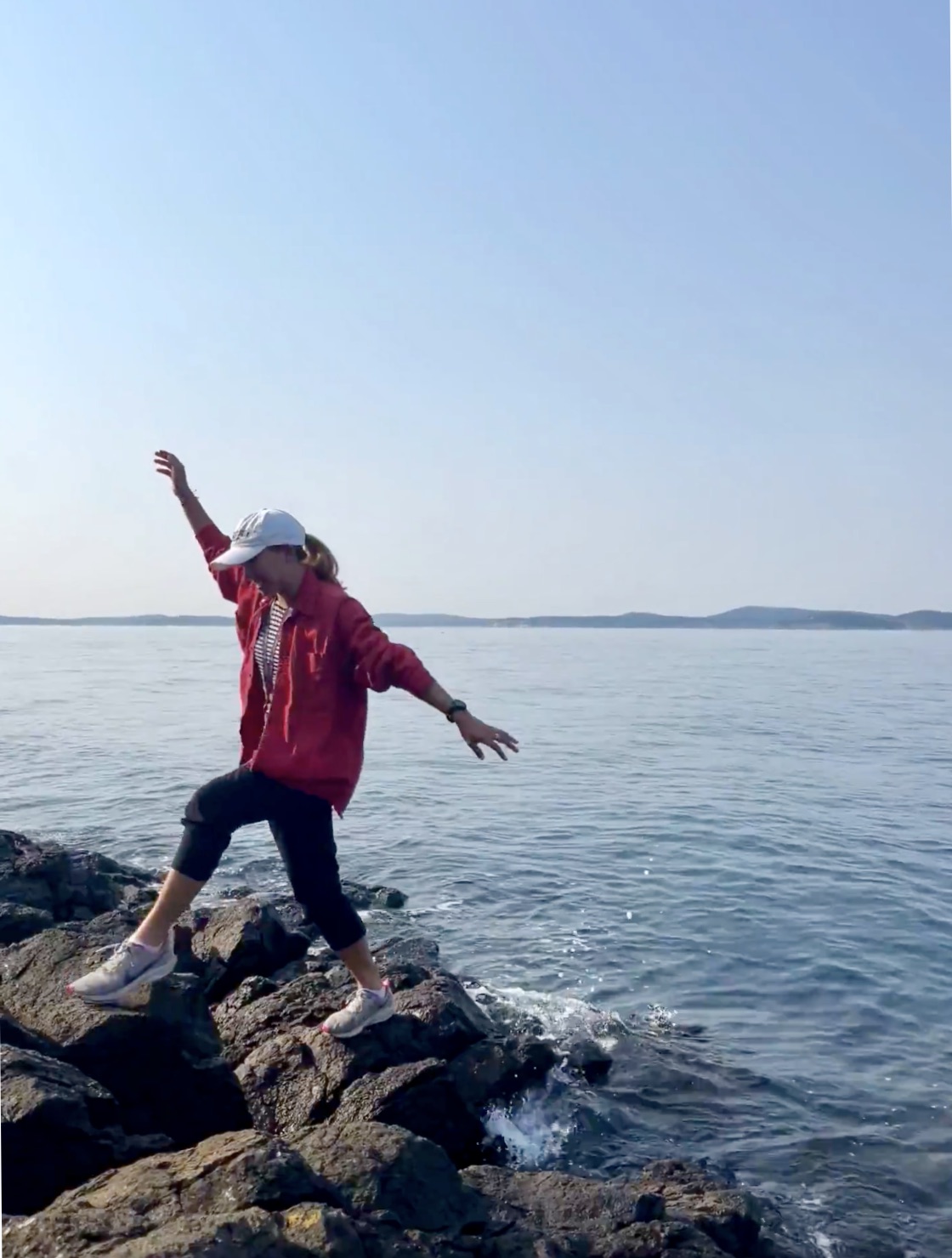
Since 2020, I have picked a Word of the Year to guide my focus, actions, and pursuit of meaning.
This year, it was Courage.
And I’m quite proud of how all of this Courage panned out.
In 2022, I told two crushes that I had feelings for them. After living in fear over what would possibly happen if someone found out, and/or wondering if they felt the same, I decided to free myself of the nerves and simply fess up. Even if the feelings weren’t reciprocated (Crush #1) or didn’t result in a relationship (Crush #2), I found that putting the truth out there set me free. It never went as poorly as the worst-case-scenarios I’d created in my mind. Surprisingly, I discovered that men deeply respect women who are forthright about their feelings. It seems that the courage of wearing your heart on your sleeve (outside of dating apps or bars) isn’t all that common in 2022.
I also exercised courage by making some big moves. I graduated college. I moved 1200 miles north. I started at a new school.
I checked some little things off my bucket list: Bleached all of my hair. Got the tattoo I’d wanted for the past five years. Skinny dipped for the first time.
And speaking of “dipping”: I cliff jumped into Crater Lake! (not naked though. This was a different instance). I should mention that I’m scared of heights. It was so terrifying I almost didn’t, and then when I finally did, I had such a rush of adrenaline, pride at my leap, and simple, childish joy that I giggled uncontrollably as I swam to the nearest rock and ended up jumping off the cliff again with my best friend. A few days later, I again confronted my fear of heights by jumping off a boardwalk with some new friends into the ocean. It was so spontaneous and unexpected; we did it halfway through a six mile run. And three weeks later, I jumped off a pier into the ocean. Each time felt like a baptism (but with much more nervous profanity).
The book How to Read Literature Like a Professor makes the case that water in literature is always symbolic— and the wetter a person gets, the more symbolic the scene is, with the ultimate significance lying in a full submersion. Each of these three leaps felt like a re-writing of myself: “I am someone who can take the leap.” I am someone who is willing to undergo some discomfort, to swim a hundred meters to shore in 50 degree water. I am someone who does the things she wishes to do, even when she is afraid, even when there are knots in my stomach and tingles in my feet. I am a new person, transformed, with trust in my ability to execute a fall correctly, to stay afloat, to get back on land regardless of the height or the cold or the anxious jitters. I can face my fears. I can do hard things.
There’s that famous quote that everyone has heard before: “Courage is not the absence of fear, but acting in spite of it.” It’s so true. If you’re wondering how to become a courageous person, the answer lies in your fear. Find your fear, and then walk straight into it.
IF YOU’RE WONDERING HOW TO BECOME A COURAGEOUS PERSON, THE ANSWER LIES IN YOUR FEAR. FIND YOUR FEAR, AND THEN WALK STRAIGHT INTO IT.
My close friend Alysa, an athlete, an inspiration— an icon!— shared her favorite quote with me this year: “Do it scared.” Yes. Being scared isn’t a bad thing, but letting your fear stop you is.
It wasn’t just the novel events where I practiced courage; I learned how to be courageous in my daily life as well:
I’m a track athlete. I’ve been doing this sport for thirteen years, so this whole Running Hard thing is nothing new. But I found that approaching my workouts with Intentional Courage completely upped my game. I remember my track days in high school, when I was unable to focus in my seventh period class because I was dreading the pain of the track workout that would follow after school. In contrast, this year, instead of dreading the pain, I began to face it with courage. I thought to myself, “It’s going to hurt, but so what? Hurt won’t kill you. The worst thing that can happen is that it will hurt.”
Perhaps Dr. Henry Cloud’s book, Boundaries, helped me with this lesson. In this book, Townsend and Cloud frequently say, “Hurt is not the same thing as harm.” It would be one thing if the pain of running was harmful to me and I was choosing not to listen to a healthy, necessary fear. In that case, ignoring my fear would simply be reckless. But the pain of lactic acid, of breathing hard, of muscles burning because I have the privileged, unique capacity to push myself to the point of such extreme discomfort— that kind of pain is not harmful. And thus, it is okay to put myself through it– good, even. The old coaching phrase is cliche, but it’s true: “Pain Builds Character.” So about courage on the track: Doing something every day that I knew would hurt, and that would hurt more the better I did it, took courage. It was hard, yes. But never once have I regretted working hard in track. Not once.
There’s a reason why they call good runners “Gutsy.” It’s because it takes courage, guts, to know that something is going to be immensely painful and to quite literally run head on into it.
When I ran 2:07 in the 800 this year, breaking a 30 year old school record at my alma mater (still getting used to calling APU that… my “alma mater”), my coach’s analysis was this: “You did not doubt yourself for a second. You just saw what you needed to do, and did it.” That’s courage right there. Not fearing what would happen if I pushed myself too hard, but just going for it. So what if there’s a little pain? Pain is temporary; the reward is lasting. And when I look back on that race, I really don’t remember much of the pain, if any at all. I remember being gusty. I remember picking up the pace where I’d usually wait a little longer for fear of kicking too early. I remember passing first place without worrying if I could keep up the pace or if I’d burn out. Being gutsy in training makes you tough; and racing with courage pays off.
More acts of courage:
- Apologizing.
- Admitting my own hurt.
- Actively pursuing conflict resolution instead of fearfully avoiding it.
- Buying a skin tight crop top. Wearing it.
- Clubbing, even though I’m terrible at dancing.
- Skipping class to go to a concert.
- Admitting that I’m a Christian, even when doing so might invoke judgment.
- Quitting my job with nothing else lined up; trusting my family to provide for me instead of relying on my own means to take care of myself.
And still! There is more to come. The year’s not over yet. And being courageous won’t stop in 2022. Next month, I am going to apply to grad school, and I’m doing so with a chance for failure, for rejection. I’ve never applied to a school I might not get into, but in the coming weeks that will change. It’s worth it though because I believe that it is better to try and to know for certain than to never try and never know. When I was 15, an elderly coach told me, “At the end of the day, it’s the things we didn’t do that we regret more than the things we did.”
I found another quote about failure this past year, about how failure isn’t really failure. Failure gives you answers. Failure means you learned. If you failed at something, it means you put yourself out there and had the courage to really try. So true failure isn’t missing your goal; true failure is not trying, not even giving yourself the chance to attain your goal. It takes guts to strive for something earnestly, something you might not get even if you put all your heart into it. That’s why I respect people who wear their hearts on their sleeves. That’s why I respect people who fail. It takes courage, and toughness, and resilience, and trust in yourself and your ability to recover, to dare to hope for something you might not even receive or achieve. But keep hoping. And keep striving. Keep taking shots, and leaping, and recreating who you are, and putting your true, yet-unrealized self out there. A life of risk and reward is better than a life of safety and unrealized potential. Be strong. Be gutsy. Have courage. Wear your heart on your sleeve. And walk into your fear. You will come out of it so, so courageous.
 The More the Marianer